Quantum Mechanics- Wave particle duality
For the last three hundred years there has been debate
whether light is made up of particles or waves. Many scientists have researched this area
such as Sir Isaac Newton in the 17th century and Thomas Young in the 19th
century, who developed the basic double slit experiment. We now know that not
only light acts like a wave but electrons can also act like waves, creating
interference patterns. This area of
physics remains an area of intrigue because we still don't know why the act of
observing an experiment changes the result.
Now physics is opened up to realities; actual and potential.
Where did the double slit experiment
come from?
The double slit experiment came about when Thomas Young
questioned Newton's theory that light was composed of a stream of
corpuscles. Newton's theory stated that
:
1. Every source of light emitted tiny particles known as
corpuscles
2.
These corpuscles are perfectly elastic, rigid, and weightless
Thomas
Young noticed some problems with Corpuscle theory such as; why different
coloured objects are refracted at different angles and explaining
interference. He came up with the double
slit concept when thinking over some of Newton's experiments as he thought
light may act in a similar way to sound. In 1800 sound was known then as a
compressed wave in air and when two waves of sound crossed they interfered. The idea that light could show an
interference pattern, if proven, would show solid proof that light is a
wave. The experiment did indeed show
that light produced an interference pattern and Young went on to measure many
of the wavelengths of different colours.
What
is light? We can see that light isn't
just what Newton said it was i.e. wasn't just tiny particles called corpuscles.
We can show this from two lasers and chalk dust. If you make the laser beams
intersect you would expect there to be a collision and that light particles
would end up going in random directions.
We can see that this isn't the case. We see that the light continues without any
collisions. But light isn't just a
wave. In the 20th century it was shown that
light when shone on metal transfers it's energy to the atoms in the metal, a
particle property. This explains that
light is made of photons, bundles of energy that act as particles and waves.
This is unlike anything seen before.
This is the beginning of the revolutionary topic Quantum mechanics.
The double slit experiment
When particles are
shot through a single slit it creates a single band. When particles are shot
through two slits it creates two bands.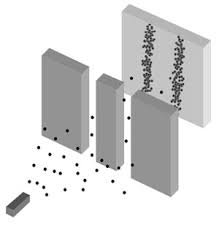
When we look at waves
we see that they act differently. When they go through a single slit we see
that they act similarly to ripples in water. But when there are two slits we
see an interference pattern. There are constructive boundaries where the
amplitude increases and destructive boundaries where the amplitude decreases.
If we shoot electrons through a single slit we see that they
act just like the particles, creating a single band. But when shot through the
double slit we see they form an interference pattern just like the waves.
What is going on ? The electron acted like the particle when
shot through a single slit, but when shot through the double slit it acted like
a wave. Scientist's first idea was that
when they shot the electrons, the electrons must have been hitting off each
over causing the interference pattern. To test this they made the electron gun
shoot individual electrons to see if the interference pattern occurred when
electrons couldn't hit each other. They
found that the interference pattern appeared again, built up slowly over
time. Their new hypothesis was that the
electrons must be splitting, going through both slits and then interfering with
each other before rejoining, just before hitting the observation screen.
What is interfering
with what ? To find out scientists used observation equipment to see if the
electrons were splitting, going through both slits and then interfering with itself.
It was shown that the electron just went
through one slit and didn't create an interference pattern. The observation screen showed that two bands were
formed, just like the particles. The process of observing the experiment
changed the result.
Why does the
observation collapse the wave function? The act of observing the electron
changes the position and energy of the electron. As the University of Oregon states, '' If the physicist
looks for a particle (uses particle detectors), then a particle is found. If
the physicist looks for a wave (uses a wave detector), then a wave pattern is
found.
The Double slit
experiment can be done with any microscopic particle. It shows us that where they hit and don't hit
the observation screen is down to their wavelike behaviour. There's more to the experiment than just
this. It shows us that the individual
waves interfere with each other. This ability
of individual states of superposition interfering with each other is key to the
microscopic world.
So what is the significance of this? It
has led to the invention of quantum computers for example. They can carry many calculations
simultaneously because they are in a superposition of states. A ten element quantum computer can carry out
1024 calculations at the same time because its in 1024 different states at the
same time. All strands of the parallel
calculation are useless if they haven't be combined. Interference combines these
calculations. Interference enables a
single answer to emerge from the 1024 different calculations. Again it is curious to note that the
superpostions can never be observed as mentioned above. What we can see is just the consequences of
their existence, the results of interference.
As with the double slit experiment it is impossible to observe an
electron going through both slits at once.
The double slit
experiment has been done many different ways.
In 1961 Claus Jonsson did the experiment with electrons. His results mirrored Young's, creating
interference patterns. In 1974 it was
possible to do the experiment with a single electron for the first time. Again the interference pattern occurred. They also added a detector and found that the
interference pattern dissapeared.
Science has
proven that light is not just a wave or made of particles, but both. It has a dual potential nature. This holds true at the quantum level. What's curious is that once a quantum entity
is observed, its actual nature is one or the other. Unlike Newtonian physics where things are or
are not, it is now shown that at the quantum level two kinds of reality exist;
actual and potential. More recently, the experiment has been performed with
photons, electrons and atoms and each time the same result occurs. This is one of the big areas of intrigue
in quantum mechanics.
